

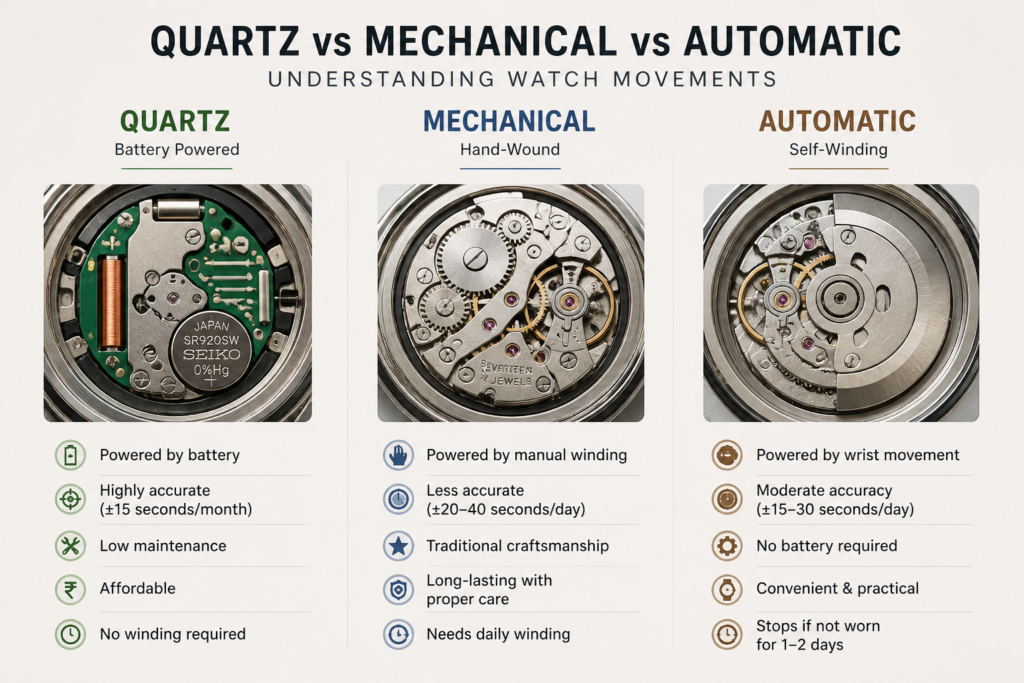
If you’re entering the world of watches, one question comes up again and again:
Should you choose a quartz, mechanical, or automatic watch?
Each type of watch movement offers a completely different experience — from precision to craftsmanship. This guide breaks it down in a simple, practical way so you can choose what actually fits your lifestyle.
What Is a Quartz Watch?
A quartz watch runs on a battery and uses a quartz crystal to keep time.
When electricity passes through the crystal, it vibrates at a consistent frequency, making quartz watches extremely accurate.
Key Features:
- Battery-powered
- Highly accurate (±15 seconds per month)
- Minimal maintenance
Pros:
- Best accuracy among all watch types
- Affordable and widely available
- No winding required
Cons:
- Lacks mechanical craftsmanship appeal
- Requires battery replacement
👉 Best for: Everyday users, beginners, and people who want reliability without effort.
What Is a Mechanical Watch?
A mechanical watch is powered by a mainspring that you wind manually.
It uses a complex system of gears and springs — no electronics involved — making it a true piece of engineering art.
Key Features:
- Hand-wound movement
- No battery or electronics
- Traditional watchmaking
Pros:
- Pure craftsmanship and heritage
- Can last decades with proper care
- Strong emotional and collector value
Cons:
- Requires regular manual winding
- Less accurate than quartz
- Higher maintenance
👉 Best for: Enthusiasts, collectors, and people who appreciate horology.
What Is an Automatic Watch?
An automatic watch is a type of mechanical watch that winds itself using wrist movement.
Inside, a rotor spins as you move your wrist, storing energy in the mainspring.
Key Features:
- Self-winding mechanism
- No battery required
- Powered by motion
Pros:
- No need for daily manual winding (if worn regularly)
- Combines tradition with convenience
- Popular among modern collectors
Cons:
- Stops if not worn for 1–2 days
- Less accurate than quartz
- Slightly higher cost
👉 Best for: People who want mechanical charm with everyday usability.
Quartz vs Mechanical vs Automatic: Quick Comparison
| Feature | Quartz | Mechanical | Automatic |
|---|---|---|---|
| Power Source | Battery | Hand-wound | Wrist movement |
| Accuracy | Very High | Low | Moderate |
| Maintenance | Low | High | Medium |
| Price Range | Budget–Mid | Mid–High | Mid–High |
| Experience | Practical | Traditional | Balanced |
Which Watch Should You Choose?
Your ideal watch depends on how you plan to use it:
- Choose Quartz if you want accuracy, low cost, and zero hassle
- Choose Mechanical if you value tradition and craftsmanship
- Choose Automatic if you want a balance between heritage and convenience
Final Thoughts
There is no single “best” watch movement — only what suits your needs.
Quartz watches offer unmatched precision, while mechanical and automatic watches provide character and history.
If you’re starting out, quartz is a smart entry point. As your interest grows, automatic and mechanical watches open the door to deeper appreciation.
FAQs
Is quartz better than automatic?
Quartz is more accurate, but automatic watches offer craftsmanship and heritage.
Do automatic watches need batteries?
No, they run on wrist movement.
Are mechanical watches worth it?
Yes, especially for collectors and enthusiasts who value traditional watchmaking.